

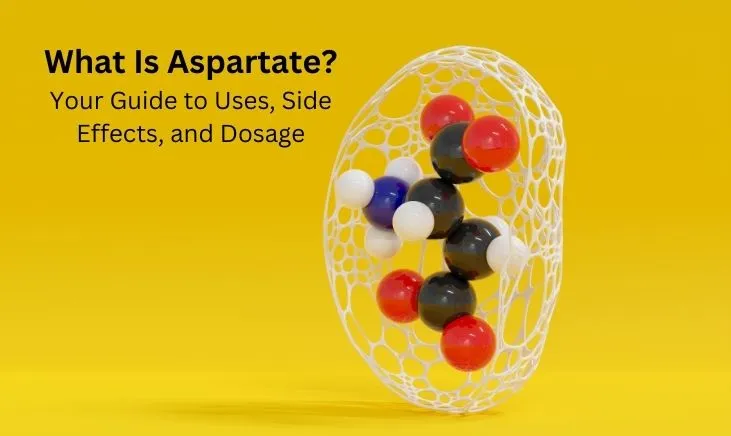
Aspartate or aspartic acid is a non-essential amino acid synthesized in the body from oxaloacetate and glutamate. Some rodent research has shown that D-aspartic acid (DAA) benefits nervous system activity, hormone synthesis and release, and male fertility, but human studies are limited.
Quick Look
- Aspartate or aspartic acid is a non-essential proteinogenic amino acid naturally synthesized in the body.
- Aspartate is available in two forms: L-aspartic acid and D-aspartic acid; the latter form of the amino acid is not used to build proteins.
- DAA has shown benefits for nervous system activity, hormone levels, and male fertility.
- The average dose of DAA acid ranges from 2,000 to 3,000 mg, but some populations may need more.
What Is Aspartate Amino Acid?
Aspartate, or aspartic acid, is a non-essential amino acid readily and naturally synthesized in the human body.
Almost all amino acids can be found in two forms: D and L Amino acids.
L and D-aspartic acid both have the same chemical formula—C4H7NO4—but they are enantiomers, meaning their molecular structures are mirror images of one another.
The easiest way to think about enantiomers is like “left-handed” and “right-handed.” They are essentially the same but can’t be superimposed on each other.
Here’s what we mean:
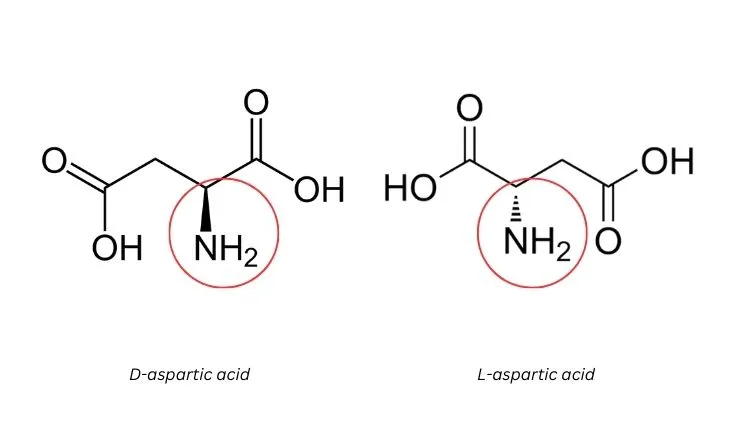
L-amino acids are typically those found in nature, including in your body, and are used to build functional proteins—these are called proteinogenic amino acids. Although L- and D-aspartic acid look similar, they have different functions. DAA isn’t involved in protein synthesis but plays an important role in synthesizing and releasing hormones.
What Does Aspartate Do?
As we said, the two forms of aspartic acid play different roles in the body:
- L-aspartic acid: Involved in protein synthesis
- D-aspartic acid: Involved in the synthesis and release of hormones
Rodent studies suggest DAA is involved in the following endocrine actions:
- Increases gonadotropin-releasing hormone (GnRH) release
- Induces oxytocin and vasopressin mRNA synthesis
- Stimulates secretion of the following hormones in the pituitary gland: prolactin (PRL), luteinizing hormone (LH), and growth hormone (GH)
- Enhances testosterone and progesterone release
Aspartic acid is also one of two acidic amino acids, the other being glutamic acid. It plays a role in activating neurons of the central nervous system and is thought to be a critical excitatory neurotransmitter.
Key takeaway: Aspartic acid is a non-essential amino acid found in L- and D-form, which play different roles in the body. L-aspartic acid is integral for protein synthesis, whereas D-aspartic acid is involved in hormone synthesis and release.
Aspartic Acid and Testosterone
As a supplement, D-aspartic acid is touted for its role in supporting testosterone levels. Testosterone is a male sex hormone involved in various aspects of men’s health and well-being:
- Libido
- Bone minerals density
- Body fat distribution
- Muscle mass and strength
- Spermatogenesis
- Erythropoiesis (red blood cell production)
- Mood and energy
So, how does DAA support testosterone?
Research studies on the effects of D-aspartic acid on testosterone production are mixed, with some studies showing positive results and others showing it’s not effective.
Here’s a breakdown of some of the research:
- A 2017 review published in the International Journal of Reproductive BioMedicine looked at 23 animal studies and four human studies. They found that exogenous D-aspartic acid enhances testosterone levels in male animal studies, but results in humans were inconsistent.
- A 2009 clinical trial on the role of DAA in the release and synthesis of LH and testosterone in humans and rats found that the amino acid was involved in the synthesis and release of LH and testosterone in humans and rats.
- A 2015 study published in the Journal of the International Society of Sports Nutrition looked at the effects of six grams of DAA on hormone levels in resistance-trained men. Subjects supplemented six grams of the amino acid for 14 days. They found that total testosterone and free testosterone levels decreased with changes in other hormones (estradiol, sex-hormone-binding-globulin, albumin). Three grams of D-aspartic acid showed no significant effect on any testosterone markers.
- A 2012 study published in Advances in Sexual Medicine found that men aged 27-43 taking DAA supplements for 90 days experience a 30-60% increase in testosterone levels.
A 3-month follow-up study published in PLoS One looked at the effects of DAA on basal testosterone levels over three months of resistance training in resistance-trained men. Researchers found the following results and concluded that DAA was ineffective at improving testosterone levels or training outcomes:
- No change in basal testosterone or free-testosterone
- 16% decrease in estradiol
- 17% increase in isometric strength of the plantar flexors (DAA and placebo group)
- Increases in hypertrophy in the quadriceps and calf muscles

Key takeaway: The research on the benefits of DAA for testosterone is conflicting, meaning the jury is still out on whether aspartic acid works for testosterone levels or not. More studies are needed to determine the efficacy of DAA and the appropriate dose to elicit benefits for testosterone levels and muscle growth.
Aspartic Acid Health Benefits
1. Supports Nervous System Function
Studies show that D-amino acids are found in the nervous and endocrine systems. DAA can be found in the nervous system of humans and controls various glands throughout the body that are responsible for producing and secreting hormones.
These hormones are essential for regulating several physiological processes, including:
- Reproduction
- Sleep
- Blood pressure
- Energy utilization
Studies also suggest that DAA plays an important role in the brain. Here’s how:
- D-aspartate is a direct N-methyl-D-aspartate receptor (NMDAR) agonist that can excite both metabotropic glutamate receptors and dopaminergic neurons in the brain
- Plays an indirect role in the initiation and progression of neurodegenerative processes
- Required for neuroplasticity, physiology, and morphology of neuronal dendrites
- Regulates gray matter volume and brain activity

2. Promotes Hormone Production and Release
The research on DAA supplements and hormone levels is mixed, with some suggesting it offers positive benefits for increasing testosterone, while others show it can actually decrease testosterone.
However, some studies have shown that aspartic acid supplements can boost levels of specific hormones, including testosterone, luteinizing hormone, progesterone, and growth hormone.

It suggests that DAA stimulates the production and release of testosterone through several pathways of the hypothalamic-pituitary-gonadal (HPG) axis. Here’s a breakdown of how it happens:
- Increases steroidogenic acute regulatory protein (StAR) gene expression in Leydig cells
- StAR is a key regulator in the transport of cholesterol from outside to inside the mitochondrial membrane
- Increasing levels of StAR may indirectly increase testosterone, as cholesterol transport is believed to be the rate-limiting step in testosterone synthesis
3. May Improve Male Fertility
Much like its effects on testosterone, the research on D-aspartic acid for male fertility is minimal, but some research suggests it has promise.
A 2012 study published in Advances in Sexual Medicine found that men aged 27-43 taking D-aspartic acid supplements for 90 days saw a significant increase in the concentration and motility of sperm, along with a 30-60% increase in testosterone levels. Researchers also found a very significant increase in pregnancies in the women partners of patients given D-aspartate; 20% of partners from one group and 33% of partners from the second group became pregnant.

Key takeaway: Research on the effects of DAA supplements is largely mixed, but some research suggests it’s beneficial for improving nervous system function, promoting hormone synthesis and release, and improving male fertility and pregnancy outcomes.
Aspartic Acid Supplements
The recommended D-aspartate or DAA dose is between 2,000 – 3,000 mg per day.
Research conducted at the University of Western Sydney states that “supplement companies are currently recommending three grams of DAA once to twice a day, and these recommendations have been drawn from the only dosage studied in humans (3 g/day).
Other studies suggest that 3,000 mg of DAA may be insufficient in some populations, especially resistance-trained individuals; a higher dose may be required to increase testosterone levels.
Aspartic Acid Safety and Side Effects
Amino acid side effects are uncommon, but it’s important to understand a supplement’s safety before adding it to your protocol.
Human studies have not reported evidence of toxicity or serious adverse effects with D-aspartic acid supplementation. However, one study of subjects with no prior health conditions reported mild side effects that included: