
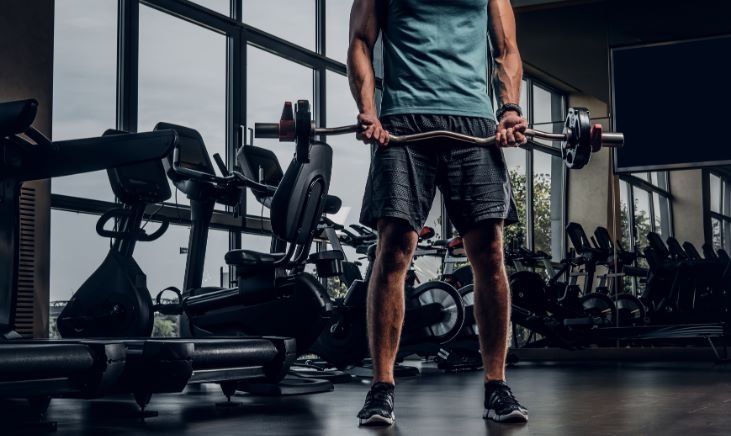
The gym is packed, and all the barbells are taken. You have limited choices on equipment, but you need to get in deadlifts for your workout session of the day—that’s where EZ bar deadlifts come in to save the day!
Though straight bar deadlifting is the most common variation, there are different types of deadlifts to try, especially when equipment accessibility isn’t always guaranteed in busy or limited gym spaces. EZ curl bars, often used for bicep and preacher curls, are a quick alternative to consider next time you’re in a stitch and want to get in your deadlifts for the day.
Our article details how to deadlift with EZ bar, along with the pros and cons compared to straight bar deadlifts so that you can get some insight into this nifty gym equipment!
How to Deadlift With EZ Bar
The EZ curl bar deadlift is a variation of the typical straight barbell deadlift that incorporates multiple grip options, such as the mixed grip. The mixed grip helps to maintain a better grip so the bar doesn’t roll out of the hands.
The proper grip hold for a deadlift is the overhand grip, though there are many other options to consider, with coinciding pros and cons. We recommend using an overhand grip for the EZ curl bar deadlift as it is easier on the wrists.
Another important factor to consider is the difference in range of motion between a curl bar deadlift and a straight bar deadlift. Bumper plates or powerlifting discs are necessary to maintain a range of motion that deters the lifter from breaking form and technique during the lift.
Too great of a range of motion will cause the back to hunch, raising the risk of injury. Therefore, it is not typical to see lifters using an EZ bar for deadlifts, though weight plates can be used with the EZ curl bar to deter this concern. Unfortunately, most EZ curl bars don’t have the appropriate sleeves to fit weight plates, which can prevent this adjustment.
Step-by-Step Instructions on How to Deadlift With an EZ Curl Bar:
- First, ensure the curl bar is set up with the appropriate weight plates—or none—for your fitness level. It’s recommended to start with a lower weight when attempting a new exercise to adjust to form and hone in on technique properly.
- The starting position begins in a shoulder-width stance, the EZ bar on the floor at your feet in front of you.
- For this deadlift version using the curl bar, prioritize an overhand grip with palms facing down to the bar. With knees slightly bent and arms extended, bend down to grip the bar just outside the thighs and stand.
- Keep the spine neutral, abs tight, and shoulders back throughout the movement.
- With knees slightly bent, hinge at the hips, pushing them back to feel a big stretch in the hamstrings.
- Bend down until the bar reaches around the middle of the shins and then return to the starting position.
- You do not want to go too low, or the back will hunch and form will deteriorate.
- This is one repetition.
EZ Curl Bar Deadlifts Muscles Worked
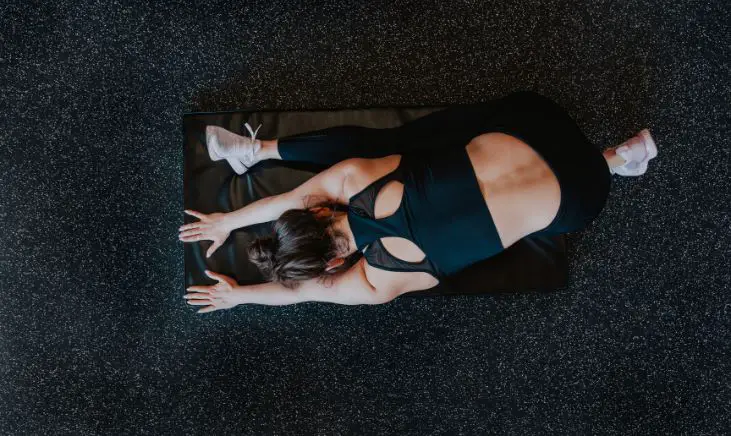
Deadlifts with an EZ curl bar prioritize the same muscle groups as any other deadlift variation, such as dumbbell deadlifts. There will be some variations in which muscles are prioritized the most throughout the movement due to the change in grip and weight placement with the EZ bar.
Primary & Secondary Muscles Worked:
- Hamstrings
- Spinal erectors
- Quadriceps
- Glutes
- Forearm
- Trapezius
- Adductors
- Abductors
- Gastrocnemius
- Latissimus Dorsi
- Abdominal Muscles
- Rhomboideus
The Pros & Cons Of Using An EZ Bar For Deadlifts
Unsurprisingly, pros and cons are associated with using an EZ bar for deadlifts. Depending on your goals, one major pro or con is that the curl bar has a lower weight limit than an Olympic barbell or deadlift bar. Keep reading to learn more about the pros and cons of EZ bar for deadlifts!

The Advantages
There are advantages to the EZ bar for deadlifts, one being it is an easy addition to any home gym. The curl bar takes up less room than a straight barbell and can be used to perform various exercises other than deadlifts, including bicep curls and tricep extensions.
For individuals not looking to lift heavy loads for safety reasons or otherwise, the curl bar is an appropriate alternative to barbell deadlifts.
Advantages Include:
- Great for home gyms
- Versatile
- Lighter weight load
The Disadvantages
As discussed previously, there are disadvantages to using the curl bar over a traditional barbell or a deadlift bar for deadlifts. One of the most pinpointed ones is the concern with form due to a broader range of motion using EZ bars compared to a straight bar. This issue is most commonly unavoidable because most curl bars do not have the appropriate sleeve size to fit bumper plates or powerlifting discs.
EZ bars also have a lower weight limit than barbells, which can affect workouts if you prioritize heavy compound lifts and hitting new PRs.
Disadvantages include:
- Lower weight limit
- Harder to prioritize proper deadlift form
- Not used in competitions
- Difficulty in progressing strength and deadlift PRs
Deadlifts With EZ Bar—Yay Or Nay?
Ideally, we recommend using a barbell for deadlifts over deadlifts with an EZ bar to incorporate a healthy range of motion that prioritizes technique and form. Straight bar deadlifts are one of the main lifts in powerlifting competitions. It is a heavy compound lift that incorporates many muscles, such as the posterior chain muscles.
There are, of course, different types of deadlifts other than the straight bar deadlift that are great alternatives over the curl bar deadlift. One excellent barbell deadlift variation is the trap bar deadlift, loaded with health and fitness benefits like lifting greater loads and achieving greater power.
The Best Bar to Use For Deadlifts
A few barbell options are ideal for deadlifts instead of the EZ bar for deadlifts. Some examples of straight barbells include Olympic bars, deadlift bars, and power bars, which come in different sizes and weights.
The Olympic bar would not be a good choice for deadlifts because of its rotating sleeves, which can make it challenging to maintain one’s grip and weight placement of the bar during the lift. The rotating sleeves are ideal for the snatch and the clean and jerk used in Olympic lifting events.
Deadlift Bar
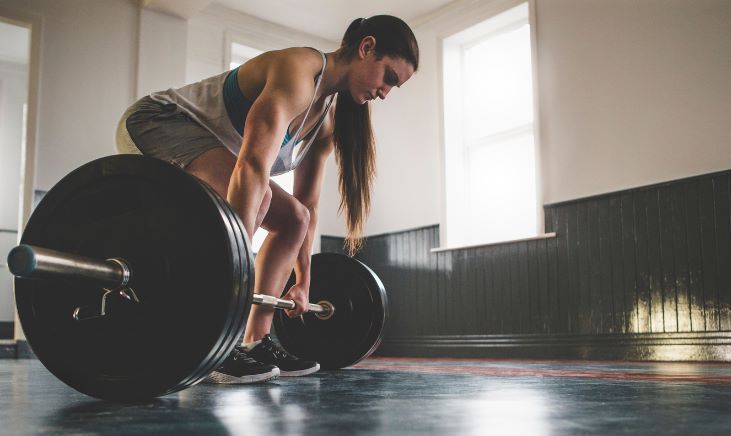
The deadlift bar is specifically designed for deadlifts, hence the name. Its design incorporates flexibility, also known as “whip,” so the bar bends. The bendability of the bar makes it more achievable to lift greater loads for strength training and heavy compound lifts, as the lifter can pull the bar up first to achieve some momentum before the plates leave the ground.
It is used in most competitions, though this varies between the deadlift bar and the power bar for what some organizations accept for lifting events that incorporate conventional and sumo deadlifts.
Power Bar
The traditional straight barbell, also known as the stiff bar or power bar, is another option to consider for deadlifts over the curl bar.
As its name suggests, the stiff bar does not offer the same bendability as the deadlift bar. For some lifters, this is ideal for training the lower portion of the deadlift movement, though there will be more of a challenge to lift heavier loads off the floor with the stiff bar when compared to the deadlift bar.
Which Exercises to Do With an EZ Bar
The design of the EZ bar is specially proposed to reduce the stress placed on the wrists and forearms in movements and isolation exercises like upright rows.
The upright row is one of the most popular shoulder exercises used with the curl bar. Its comfortable grip is perfect for maintaining good form and decreasing strain on the wrists compared to a straight bar.
Some other exercises, which mainly focus on the upper body, pair outstandingly well with the functionality of the EZ curl bar.
Recommended EZ Curl Bar Exercises:
- Preacher curl
- Bicep curl
- Upright row
- Reverse curl
- Bent over row